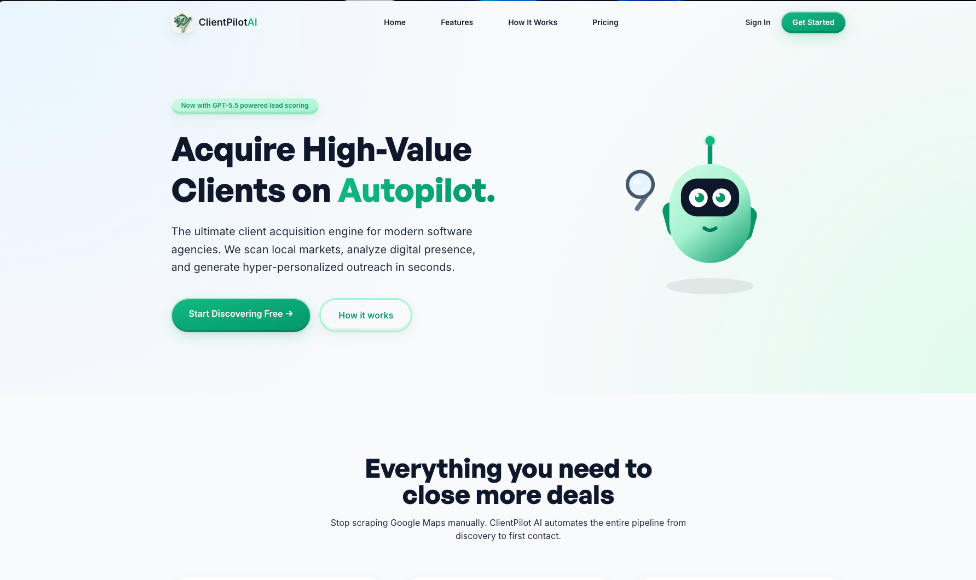
Client Pilot AI scans local markets for businesses that need software, scores them, and drafts a technical proposal by retrieving similar past projects. We built it for our own pipeline and run it in production.
Drawn first. Then built, layer by layer.
- L1 Client
- L2 API
- L3 AI pipeline
- L4 Data & hosting
- ▣ Rendered product
The problem
Qualifying a lead, researching a solution and writing a tailored proposal takes hours per prospect, so first replies go out late. The work is repetitive enough to automate, but needs grounding in real past projects to be useful.
How we approached it
- 01Designed a retrieval pipeline (RAG) first: past projects are embedded and stored next to their scope, stack and timeline.
- 02Each new lead is matched against that history, so the model drafts from real precedent instead of guessing.
- 03Split the product into a Vercel-hosted dashboard and a Railway-hosted Node API so model calls never block the UI.
- 04Used Supabase for Postgres, vector search and auth to keep the moving parts to one managed service.
Numbers, with sources
- Lead discovery and scoring
- Retrieval-grounded proposal drafts
- Pipeline dashboard for tracking outreach
- Support for more than one LLM provider
The stack
Client Pilot AI is our own tool. We use it daily, but we have not run a controlled study, so we do not quote accuracy or conversion percentages.
What shipped
- Client
- React · TypeScript · Tailwind CSS
- API
- Node.js · Express
- AI
- Embeddings · retrieval · multi-provider LLM
- Data & auth
- PostgreSQL · pgvector · Supabase Auth
- Hosting
- Vercel · Railway


Want your system drawn like this?
A 30-minute Google Meet call with one of our co-founders. We sketch the architecture with you, tell you honestly what it takes, and send notes afterwards, whether or not you hire us.